Mixed martial arts is often described as a combination of fighting styles. That is accurate, but it does not explain what makes MMA so technically demanding.
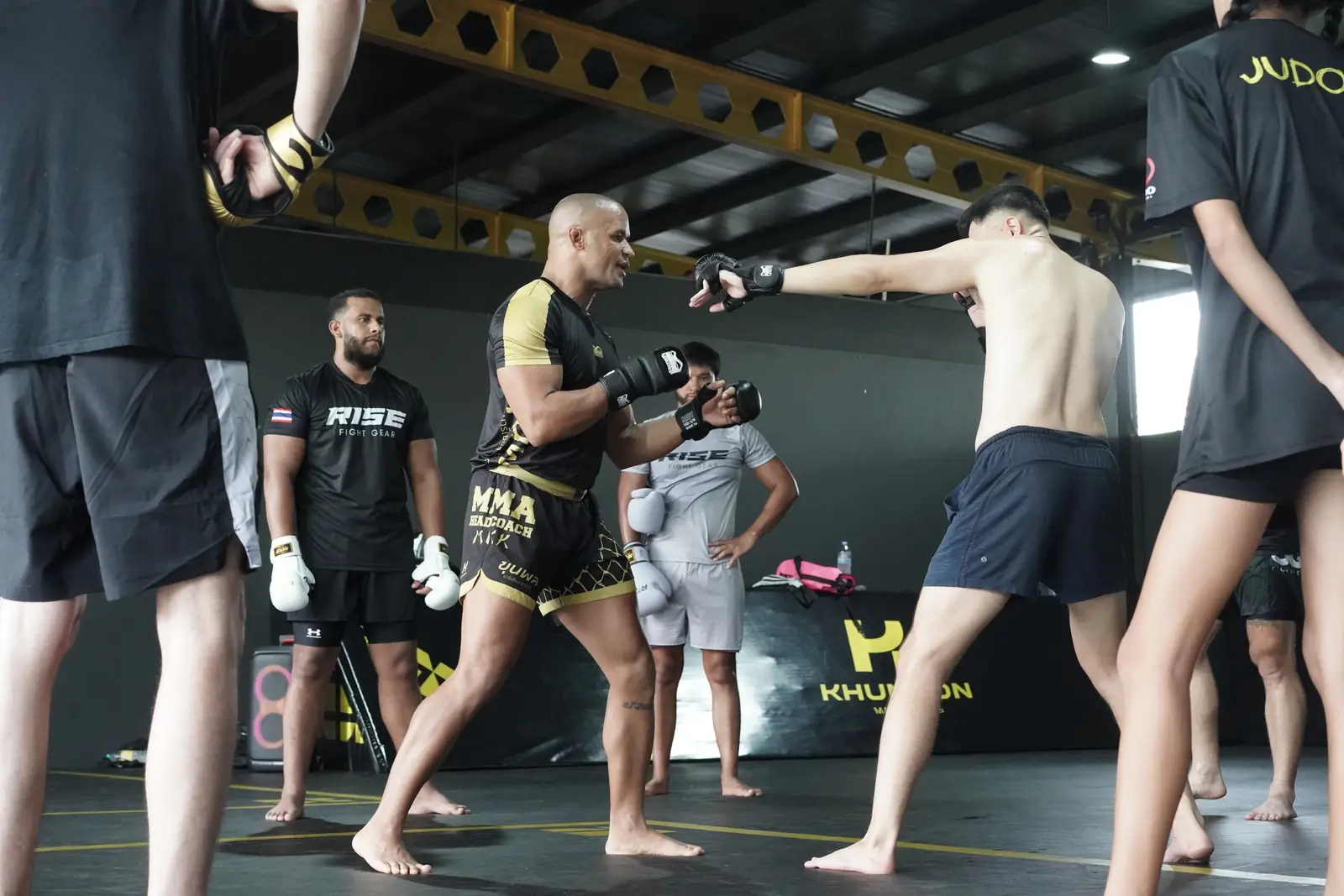
A modern MMA fighter must strike at distance, defend takedowns, work from the clinch, control positions against the cage, escape from the ground and make good decisions while tired and under pressure. At Khunpon in Phuket, that range of skills is reflected in how you can train: through MMA, Muay Thai, Brazilian Jiu-Jitsu and No-Gi grappling, strength and conditioning, personal training and open gym access.
Whether you are completely new to martial arts, an experienced striker or grappler, a travelling athlete or preparing to compete, Khunpon gives you a practical environment in which to learn the different parts of MMA and connect them.
What is MMA?
Mixed martial arts is a rules-based combat sport involving striking, wrestling, takedowns, clinch work, ground control and submissions. Unlike a single-discipline sport, MMA moves through several ranges:
- Long range, where fighters use punches, kicks and movement.
- Boxing range, where combinations, defence and counters take over.
- The clinch, where fighters use underhooks, head position, trips, knees and short strikes.
- The takedown phase, where one fighter tries to bring the other to the ground.
- The ground, where position, submissions, escapes and controlled striking decide what happens next.
The objective is not to collect techniques from different martial arts. Effective MMA needs those techniques to work together. A boxer must understand how a punch affects their balance and takedown defence. A Muay Thai fighter must know how to respond when an opponent changes level. A grappler must be able to enter safely against strikes and get back to their feet when necessary.
That is why MMA at Khunpon is connected to the wider training culture of the gym. The striking you build through Muay Thai and boxing supports your MMA, while BJJ and No-Gi grappling teach control, transitions and submissions.
How did modern MMA develop?
MMA has several historical influences, and its development was not a single straight line.
Ancient Greek pankration is sometimes described as an early form of mixed combat because it combined wrestling and striking. It is a useful historical comparison, but it is not the direct origin of modern MMA: the rules, training systems and sporting structures are very different.
Modern MMA grew out of a much more complicated history of challenge matches, cross-style contests and combat sports. Brazilian vale tudo competitions played an important role in showing how different martial arts performed against one another. Brazilian Jiu-Jitsu became particularly influential after Royce Gracie won the first UFC tournament, submitting several larger opponents; the UFC's own account dates that first event to 12 November 1993.
Other wrestling-based systems, including catch wrestling and shoot wrestling, also fed into cross-style fighting. These influences are best treated as parallel strands rather than one line of descent. A scholarly study of vale tudo in Curitiba by Passos, Prado, Marchi Júnior and Capraro, for example, highlights local memories, identity and sporting culture rather than presenting a neat progression towards today's MMA.
The early UFC helped popularise the idea of different styles competing in one event. Over time MMA became more regulated: weight classes, timed rounds, gloves, medical checks, referees, judging criteria and athletic-commission oversight turned it into a modern professional sport rather than an uncontrolled contest.
The Unified Rules of Mixed Martial Arts were adopted in 2001 and have been amended since. Individual commissions, promotions and amateur bodies may apply variations, so fighters must always understand the rules of the specific event they are entering.
Which martial arts are used in MMA?
Boxing
Boxing brings punching technique, combinations, footwork, head movement, defence and timing. In MMA it has to be adapted, because punches are thrown alongside kicks, level changes and takedown attempts.
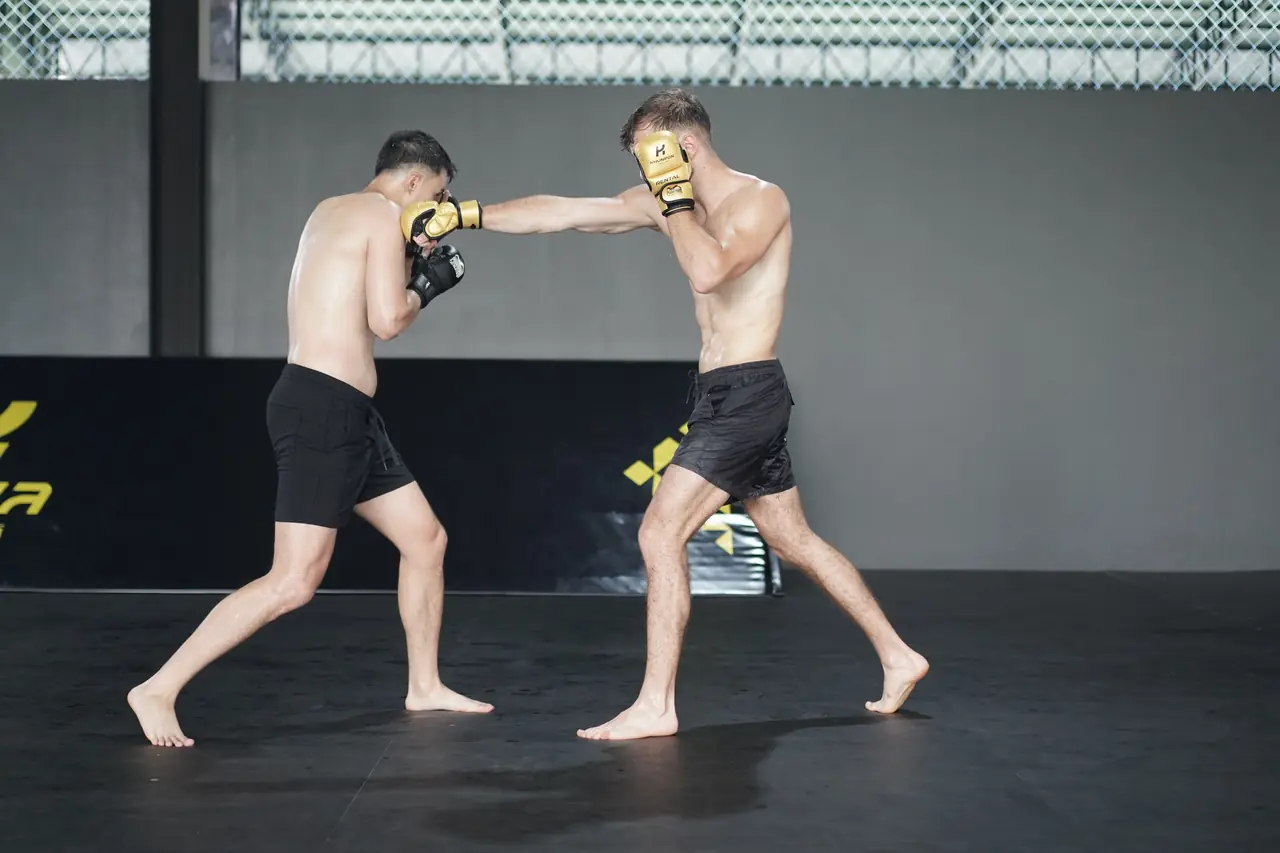
At Khunpon, boxing skills support both dedicated striking and MMA. A fighter needs to know not only how to land a punch but how to stay balanced and ready to defend the next phase of the exchange.
Muay Thai
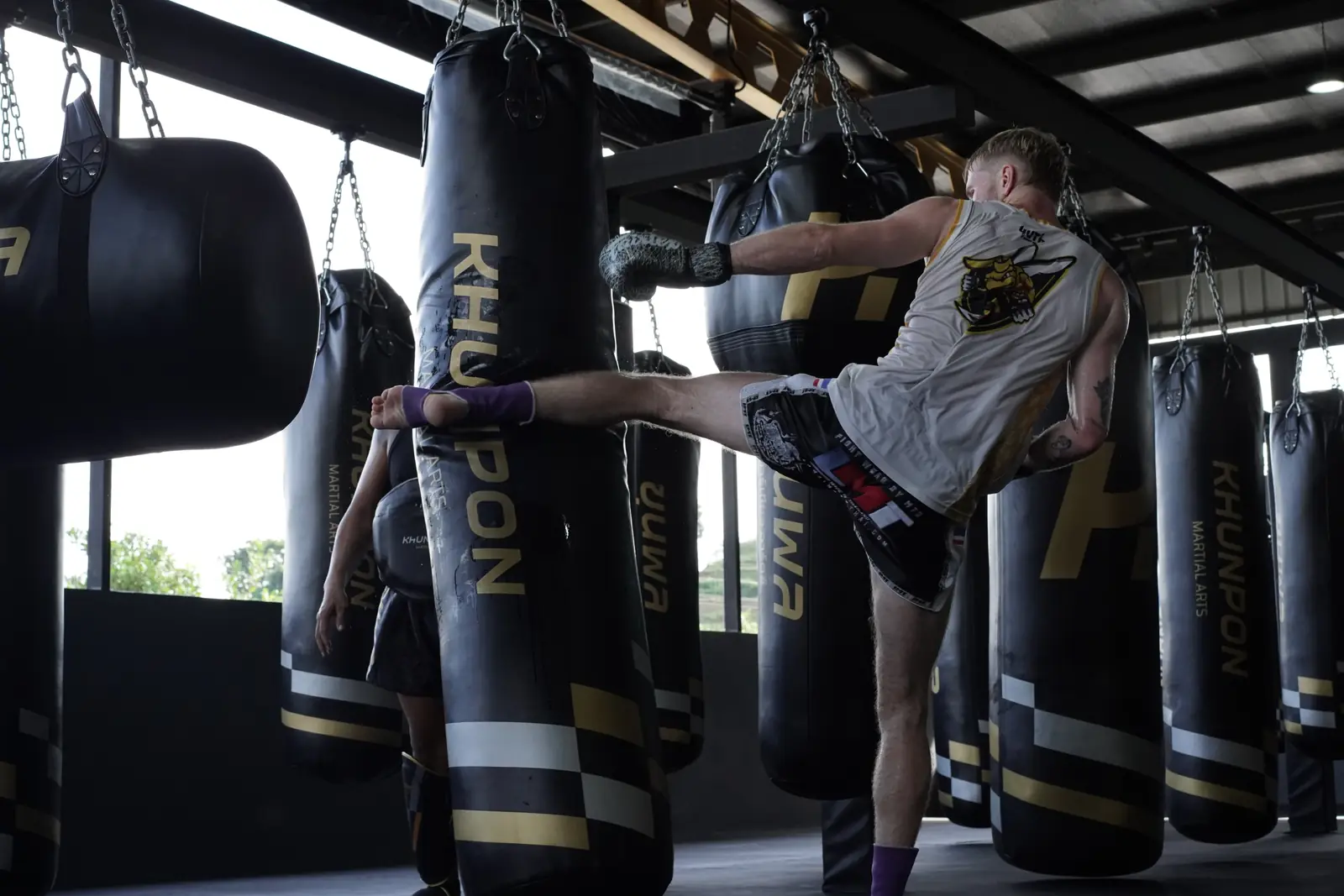
Muay Thai is central to Thailand's combat-sports culture and brings punches, kicks, knees, elbows and clinch work. Its emphasis on balance, composure and close-range control makes it highly relevant to MMA.
MMA fighters adapt Muay Thai carefully. A tall stance may help with kicks and knees, but it can also open the door to takedowns. The goal is not to strip away Muay Thai's identity but to apply its strengths within MMA. Khunpon's Muay Thai coaching lets athletes build these striking fundamentals in Phuket while understanding how they connect to wrestling and grappling.
Wrestling
Wrestling provides takedowns, sprawls, scrambles, pressure, positional control and the ability to dictate where an exchange happens. A strong wrestler may choose to keep a fight standing, take an opponent down or use the cage to wear them down. For a striker, wrestling defence is essential: it creates space and returns you to your preferred range.
Brazilian Jiu-Jitsu and No-Gi grappling
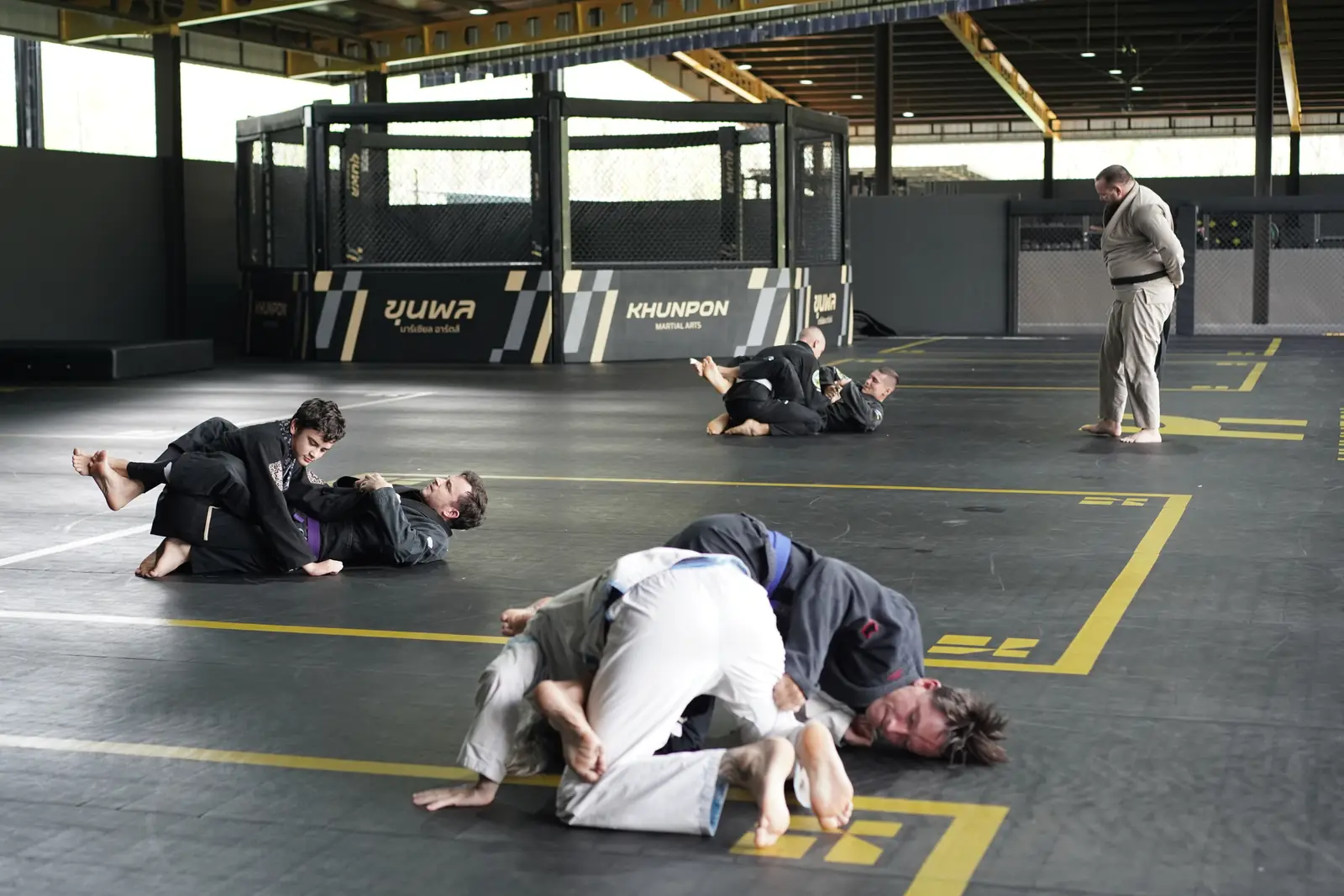
Brazilian Jiu-Jitsu brings positional control, guard work, escapes, back control and submissions. No-Gi grappling is especially relevant to MMA because there are no grips on a uniform. Ground training at Khunpon teaches what happens after a takedown: how to stay safe, improve position, defend submissions and work towards a controlled finish or a return to standing. Read more in our BJJ guide.
Judo, sambo and catch wrestling
Judo contributes throws, trips and balance-breaking from the clinch. Sambo has influenced many modern grapplers through its mix of takedowns, leg attacks and positional fighting. Catch wrestling brings its own history of pins, pressure and submission holds.
The most effective MMA training does not treat these arts as separate boxes. It identifies what works under MMA rules and teaches you to connect each skill to striking, wrestling and cage movement.
Why does the cage matter?
The cage changes MMA significantly. In open space you can move in several directions. Against the fence, that space disappears. The cage can prevent a takedown, help one, restrict movement or give a fighter something to use for balance and control.
Cage wrestling is much more than pushing an opponent backwards. You need to understand:
- Underhooks and overhooks.
- Head position.
- Hip placement.
- Takedown entries and defence.
- Hand fighting.
- Wall control.
- Escapes and reversals.
- How to strike without losing balance.
The cage can also make a defensive fighter work harder. Pinned against it, you may be unable to use your usual footwork, while the attacker must keep the pressure on without becoming vulnerable to a reversal. That is why MMA coaching at Khunpon deals with transitions and positioning as well as individual techniques: a kick, takedown or submission cannot be judged apart from what happens just before and after it.
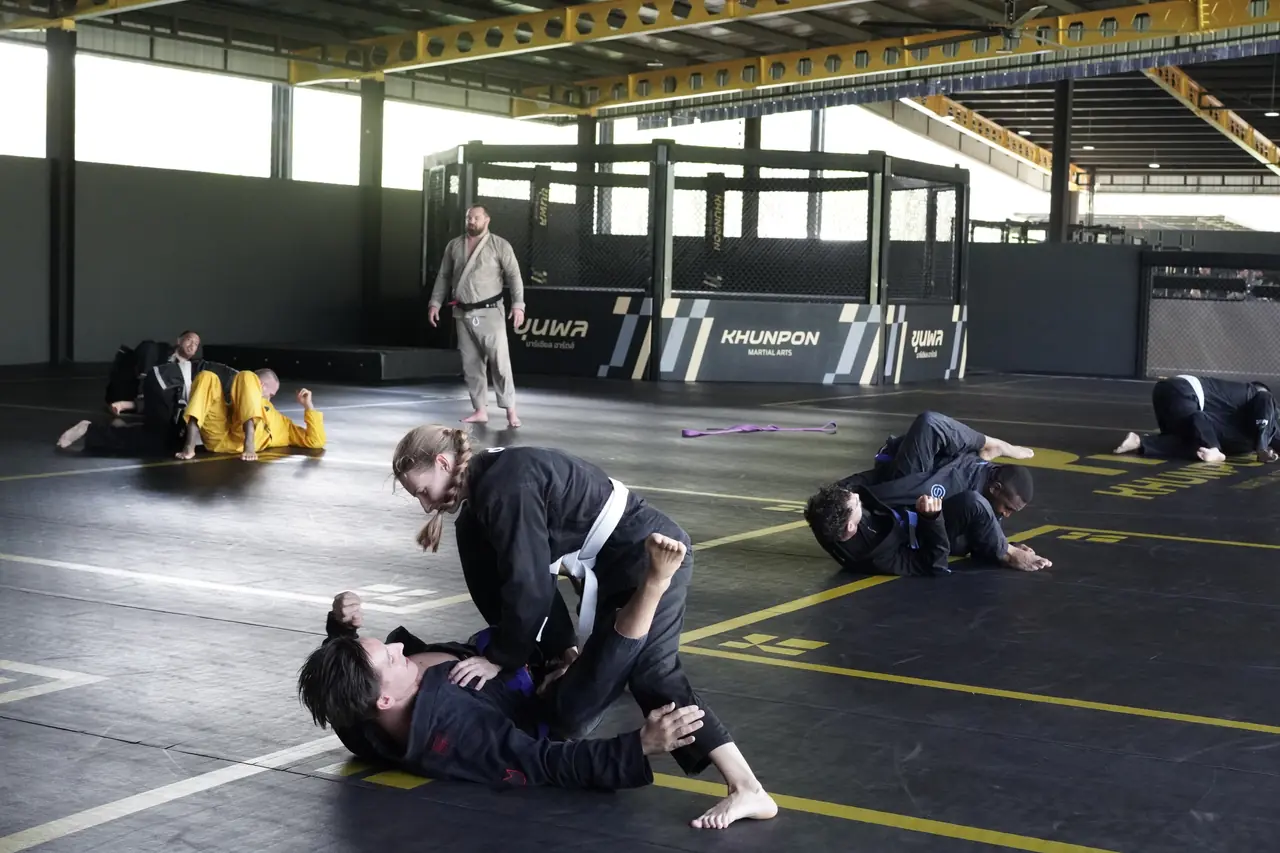
At Khunpon there is a 24-foot octagonal cage and 40 metres of cage wall, so you can train wall work in the conditions you will fight in.
The International Mixed Martial Arts Federation explains that the cage also stops athletes falling out of the competition area during wrestling exchanges (IMMAF, What is MMA?). It is both a safety feature and a central part of MMA strategy.
How does an MMA fight work?
The exact format depends on the promotion, commission and level of competition. Under the Unified Rules, professional rounds are generally five minutes long with a one-minute rest, with a maximum of five rounds in a bout.
A fight may end by:
- Knockout.
- Technical knockout.
- Submission.
- Decision.
- Technical decision.
- Referee stoppage.
- Doctor or medical stoppage.
- Disqualification.
- Verbal submission or verbal stoppage.
The referee manages the contest and can stop it when a fighter can no longer intelligently defend themselves or when continuing would be unsafe.
MMA also has fouls, including strikes to the back of the head or spine, eye gouging, biting, attacks to the groin and certain attacks on a grounded opponent. The definition of a grounded opponent and the rules around knees and kicks vary between rule sets, so check the regulations before you compete.
Amateur MMA has its own considerations. IMMAF maintains amateur rules built around safety and international competition, and reviews its rulebooks periodically (IMMAF 2025 rules update).
How is MMA scored?
Under the Unified Rules, MMA is judged on the 10-point-must system. Judges look first at effective striking and effective grappling, with damage, meaningful offence and positional work contributing to the overall picture.
A fighter may appear to control a position without doing enough effective work to win the round. Another may spend less time on top but create more damage or submission danger. Activity matters, but effectiveness is the central question.
Promotions may apply their own judging approach. ONE Championship, for example, states that its judges assess the bout as a whole rather than round by round, looking at near knockouts or submissions, damage, effective striking, cage or ring control, ground control, takedowns, takedown defence and aggression.
That is one reason MMA athletes must train for complete exchanges. Winning one moment does not necessarily win a round or a fight: you need effective offence while managing risk, fatigue and position.
Major MMA organisations and competition pathways
MMA has a broad international landscape. Promotions organise events and sign athletes, while commissions and federations provide rules, oversight or amateur structures.
- The UFC is one of the most established global MMA promotions and played a major role in bringing modern MMA to a worldwide audience.
- ONE Championship runs an international promotion with its own Global MMA Rule Set.
- The Professional Fighters League uses a distinct competition model, with formats that vary by season and event. Its 2025 World Tournament rules, for example, used tournament brackets and advancement through successive stages.
- Cage Warriors is a European professional promotion with a long-standing role in developing fighters.
- RIZIN is a Japanese promotion with its own event identity and regulations.
- IMMAF is an international amateur federation rather than a professional promotion. It organises amateur competition and develops standardised rules and event protocols.
- Bellator has also been historically important to modern professional MMA.
If you train at Khunpon with competitive ambitions, this distinction matters. A gym may support athletes preparing for different kinds of competition, but the preparation should always reflect the rules, level and expectations of the specific event. Khunpon also runs its own MMA Team tryouts for fighters who want to compete for the gym.
What learning MMA involves
Learning MMA means developing skills across several ranges and then learning how to move between them. At Khunpon you can approach that in different ways. Group classes give you a shared training environment, while personal training lets the coaching fit your experience, goals and priorities more closely. Some students train for fitness, confidence and enjoyment; others are developing one discipline, preparing for competition or combining several areas of training.
A complete MMA programme may involve:
Stance, movement and distance
You learn to keep your balance, manage range, enter safely and create exits. MMA footwork has to account for punches, kicks, takedowns and the cage.
Striking
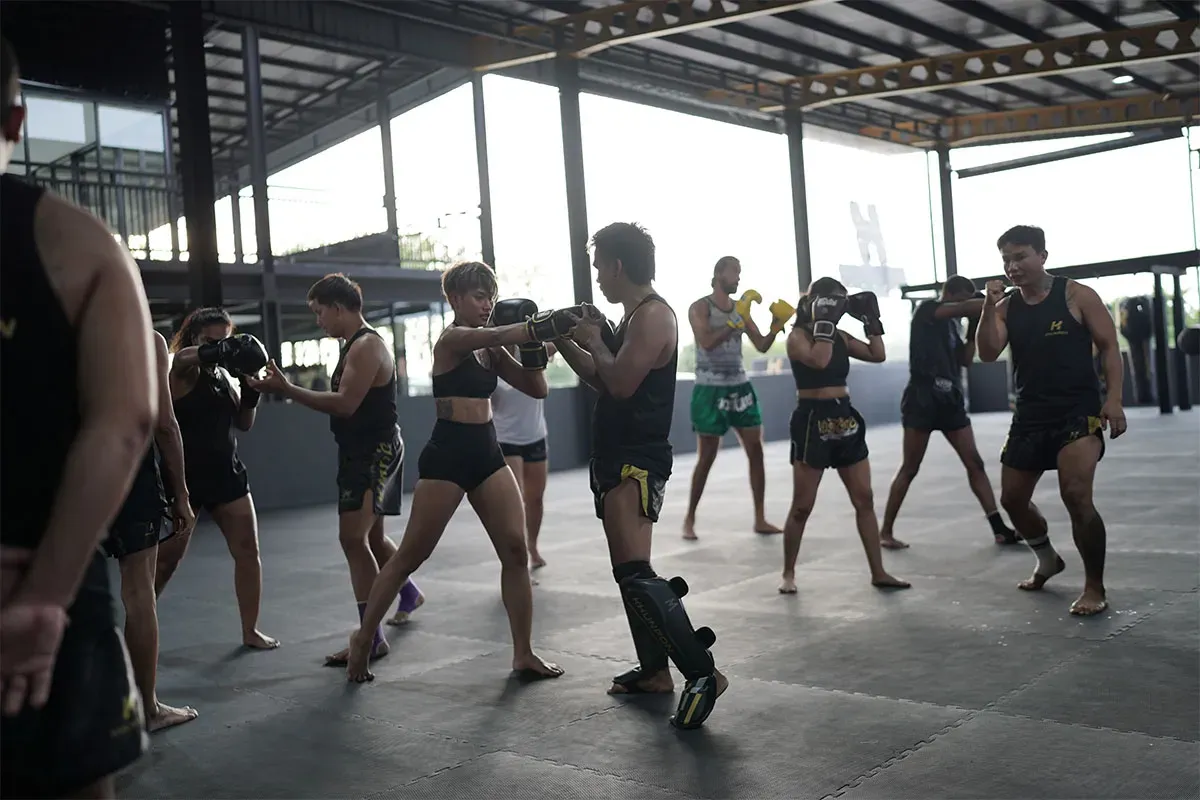
Technical combinations, defensive movement, pad work, bag work, partner drills and controlled sparring where appropriate. The emphasis is on timing, accuracy, balance and decision-making rather than simply hitting harder.
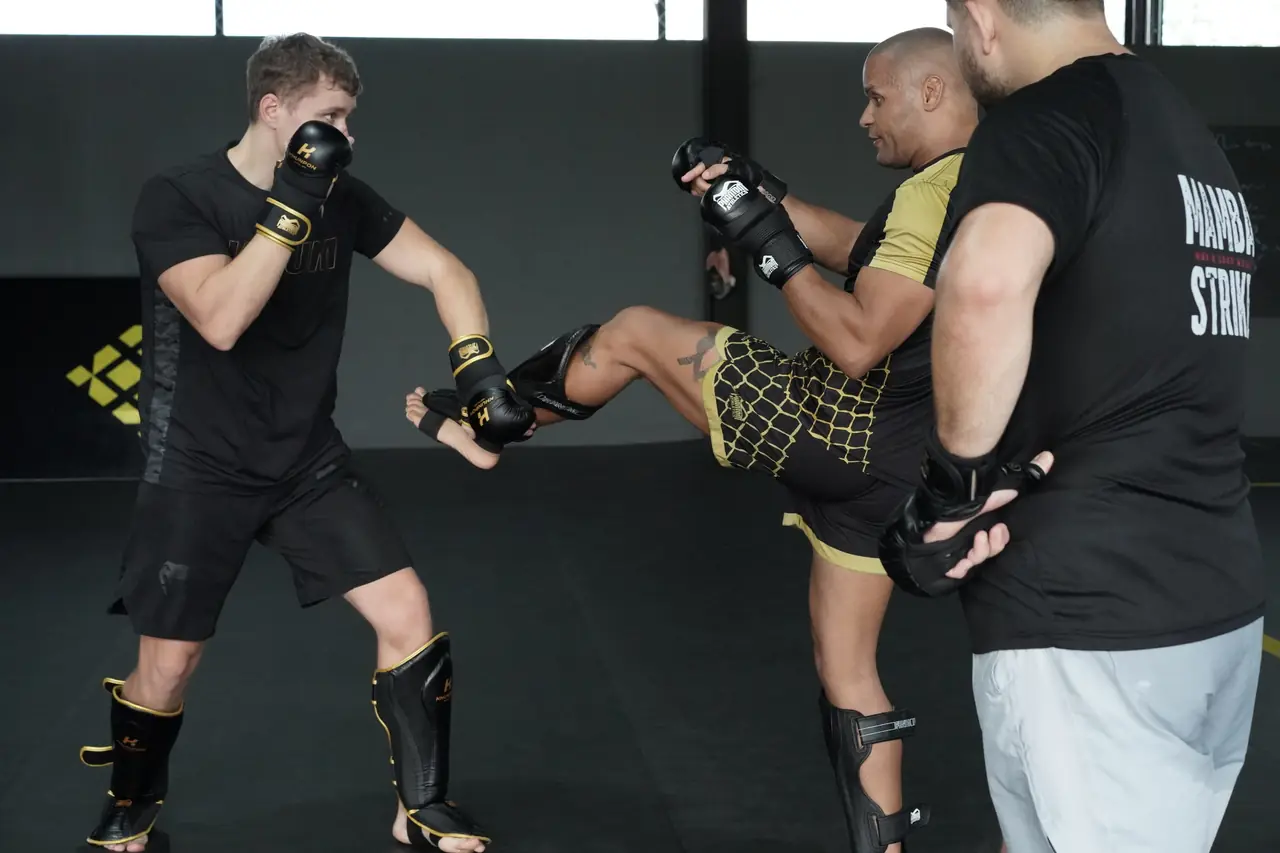
Takedowns and wrestling
You learn to read level changes, defend entries, use underhooks, finish takedowns and get back to standing. Wrestling also teaches you how to work when an opponent refuses to engage at long range.
Clinch fighting
The clinch connects striking and grappling. You learn to control posture, hand fight, use knees or short strikes where permitted, create takedowns and avoid being turned or taken down.
Ground positions and submissions
Ground training develops positional awareness, escapes, guard passing, back control, mount work and submission defence. It also teaches you to stay calm when an opponent is applying pressure.
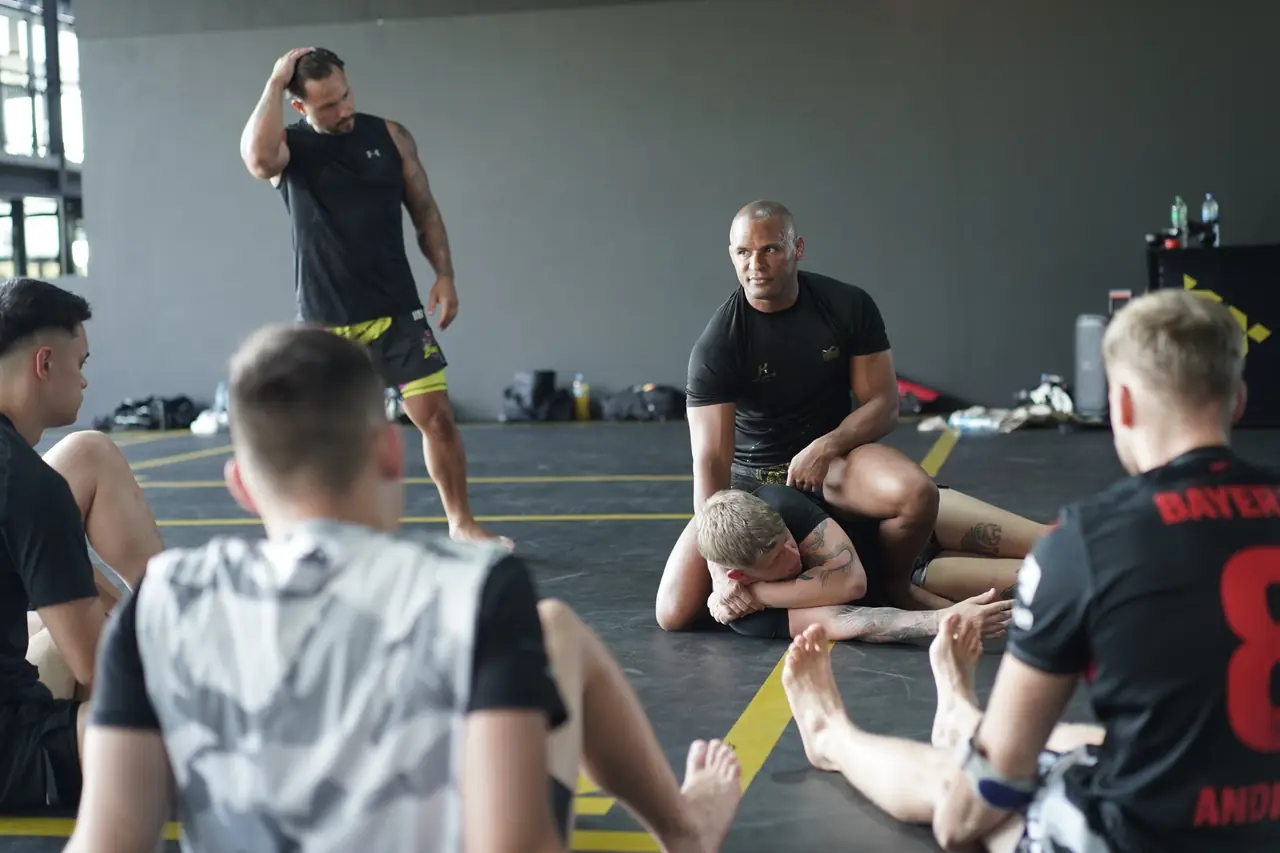
Cage awareness
MMA-specific training includes how the fence affects movement, takedown defence, escapes and control, which is different from training only on an open mat.
Strength, conditioning and recovery
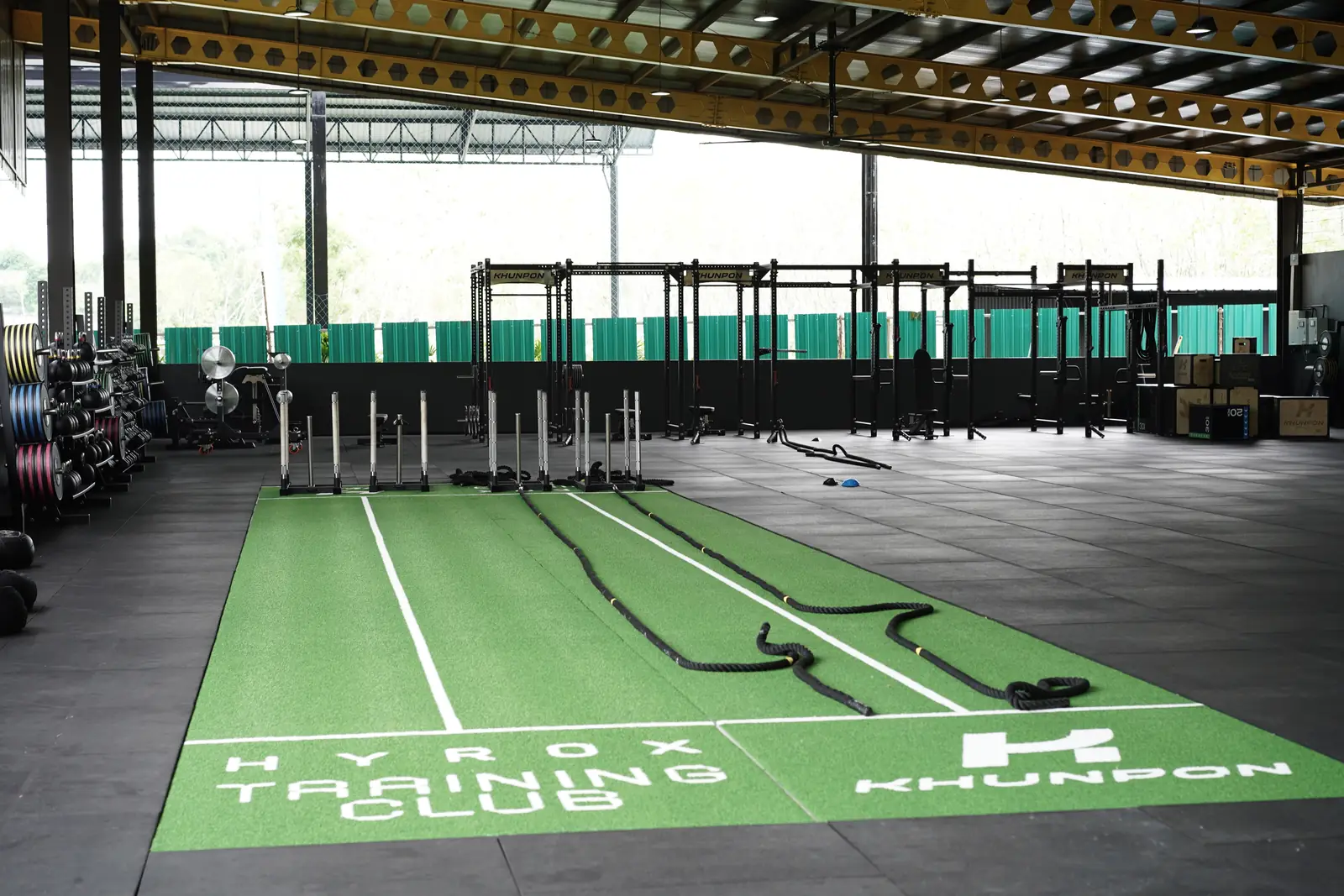
MMA places demands on the whole body and on the ability to repeat intense efforts. Strength and conditioning supports power, work capacity, movement quality and resilience. Recovery, sleep, mobility and sensible training loads matter just as much.
You do not need an MMA background to start at Khunpon. The fundamentals are introduced progressively, while experienced athletes can refine transitions, fix technical weaknesses and prepare for higher-level demands.
What makes MMA technically difficult?
MMA is difficult because no phase stays isolated for long. A fighter may start with a jab, defend a takedown, work from the fence, escape a submission attempt and return to striking in the same exchange, and each transition shifts the contest.
Some of the most demanding areas:
- Keeping striking balance while defending takedowns.
- Entering wrestling range without walking onto knees or uppercuts.
- Using kicks without giving away an easy catch.
- Escaping the cage without exposing the back.
- Managing underhooks, head position and hip pressure.
- Defending submissions while staying aware of strikes.
- Making good choices while fatigued.
- Switching from attack to defence right after a missed technique.
This is where Khunpon's multi-discipline set-up helps. The gym brings together MMA, Muay Thai, BJJ and No-Gi grappling alongside strength and conditioning, so you can work on one area while learning how the pieces fit together.
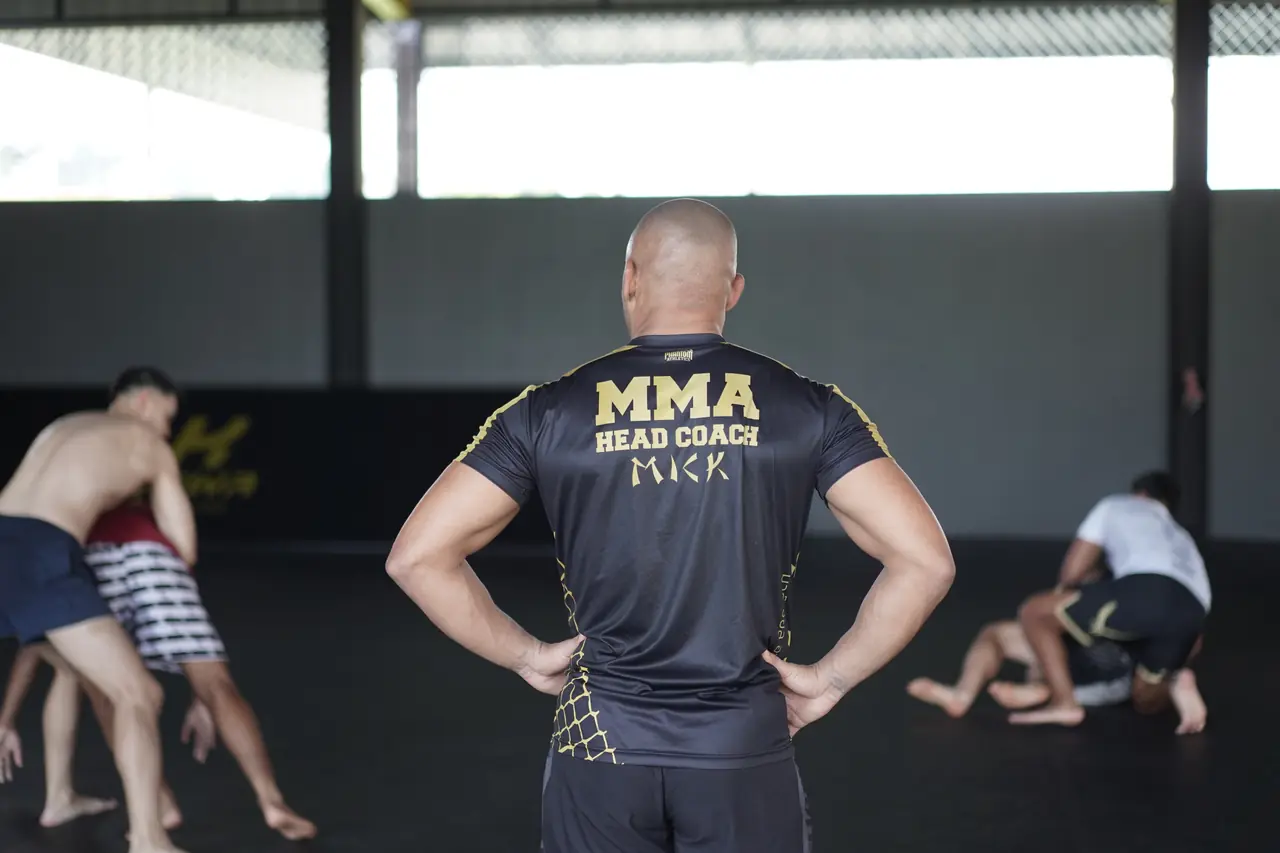
Khunpon's coaching team also brings different technical strengths and perspectives. That gives you more than one way to approach a problem: a striking issue can be examined through Muay Thai, a positional issue through grappling and a conditioning issue through structured physical preparation.
Why train MMA in Phuket?
Thailand is internationally recognised for its Muay Thai culture, and Phuket has become a major destination for martial artists from around the world. That creates an unusually varied training community of local practitioners, long-term residents, visiting athletes and people taking their first steps into combat sports.
Training in Phuket still calls for a responsible approach: realistic expectations, respect for local culture, attention to heat and recovery, and the understanding that real progress comes from consistency rather than cramming in as much training as possible.
Khunpon gives you a place in Phuket to connect striking, grappling, MMA and physical preparation in one gym, whether you are visiting and want to train during your stay, live locally and want a long-term routine, or are an experienced martial artist adding another discipline to your game.
What makes Khunpon different?
Khunpon's strongest point of difference is its connected training environment. MMA students can develop their whole game while training the disciplines that support it: Muay Thai and boxing for striking, BJJ and No-Gi grappling for control and submissions, strength and conditioning for athletic preparation, and MMA coaching to bring it together through transitions and decision-making.
The gym is built for different kinds of people. Complete beginners learn in a structured setting. Recreational members train consistently without needing to compete. Travelling athletes join an international community. Experienced competitors and professional fighters sharpen their preparation.
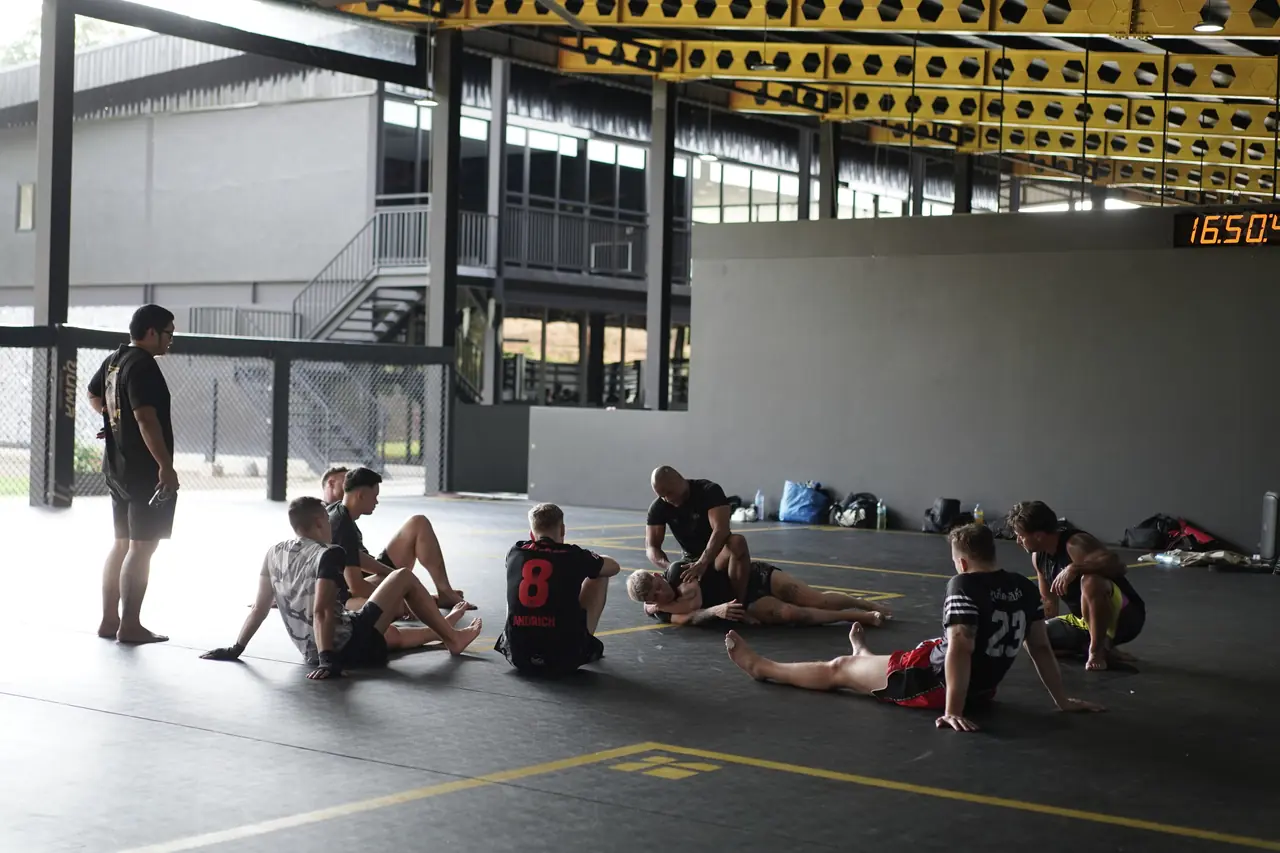
The word "family" only means something when it describes how people behave. At Khunpon that means training partners sharing space, coaches helping students progress, experienced members setting the standard for newcomers and people with different goals training side by side. It matters because combat sports are demanding: a strong gym keeps people consistent, respectful and focused, and lets them grow without feeling they must prove themselves before they belong.
Begin your MMA training at Khunpon
MMA at Khunpon is open to people at every stage: learning the fundamentals, improving fitness, combining Muay Thai with grappling, preparing for competition or building a long-term martial-arts practice. Group classes run Monday to Friday from 16:00 to 17:30 under MMA Head Coach Mick.
See the MMA programme, explore the timetable or contact the team about the best starting point for your experience and goals. Train with purpose, learn across disciplines and become part of the Khunpon training community in Phuket.
MMA glossary
- MMA
- Mixed martial arts, a rules-based combat sport combining striking, wrestling, grappling and submissions.
- Vale tudo
- A Brazilian term for open-style, "anything goes" combat contests. Historically related to MMA, but not the same as modern regulated MMA.
- Pankration
- An ancient Greek combat sport combining striking and wrestling. A historical comparison, not a direct modern ruleset.
- Clinch
- Close-range fighting in which athletes control each other's upper body, posture and position.
- Takedown
- Bringing an opponent from standing to the ground.
- Sprawl
- A defensive movement that stops or weakens a takedown attempt.
- Underhook
- An arm placed underneath the opponent's arm to improve control and defensive options.
- Guard
- A ground position in which one fighter uses their legs to control an opponent from underneath.
- Mount
- A dominant ground position sitting above the opponent's torso.
- Back control
- A dominant position behind an opponent, usually controlling the upper body or legs.
- Submission
- A technique that forces an opponent to surrender, or makes the referee stop the contest.
- Ground-and-pound
- Striking while controlling an opponent on the ground.
- Cage control
- Using the fence and positioning to limit an opponent's movement or create attacking chances.
- Unified Rules
- A widely used framework for regulating professional MMA, with variations between commissions and promotions.
- Decision
- A result decided by the judges when the fight reaches the end of its scheduled time.
Sources and further reading11
- Association of Boxing Commissions and Combative Sports. Unified Rules of Mixed Martial Arts.
- UFC. UFC History.
- UFC. UFC 30th Anniversary.
- International Mixed Martial Arts Federation. What is MMA?
- International Mixed Martial Arts Federation. 2025 Rules Update.
- ONE Championship. Martial Arts Rules and Regulations.
- Professional Fighters League. 2025 World Tournament Rules.
- Cage Warriors. Official website.
- RIZIN Fighting Federation. Official English website.
- Passos, D. A., Prado, R. C., Marchi Júnior, W. and Capraro, A. M. "The origins of vale-tudo in the city of Curitiba, PR".
- Khunpon Martial Arts. MMA in Phuket.