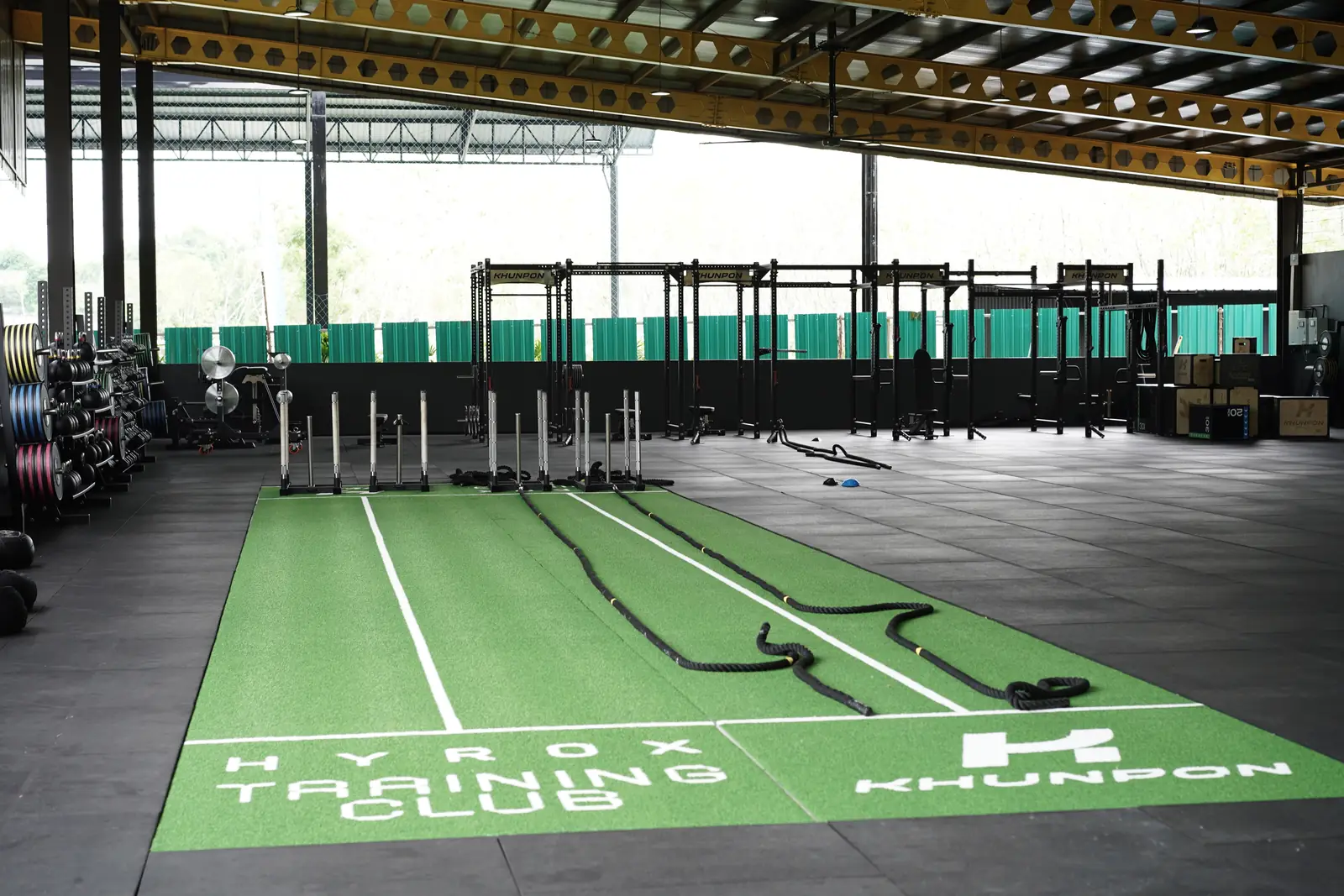
HYROX is a fitness race that combines running with functional exercise stations in a consistent, measurable format. It gives runners a new strength challenge, gives strength athletes an endurance target and gives training partners a shared goal.
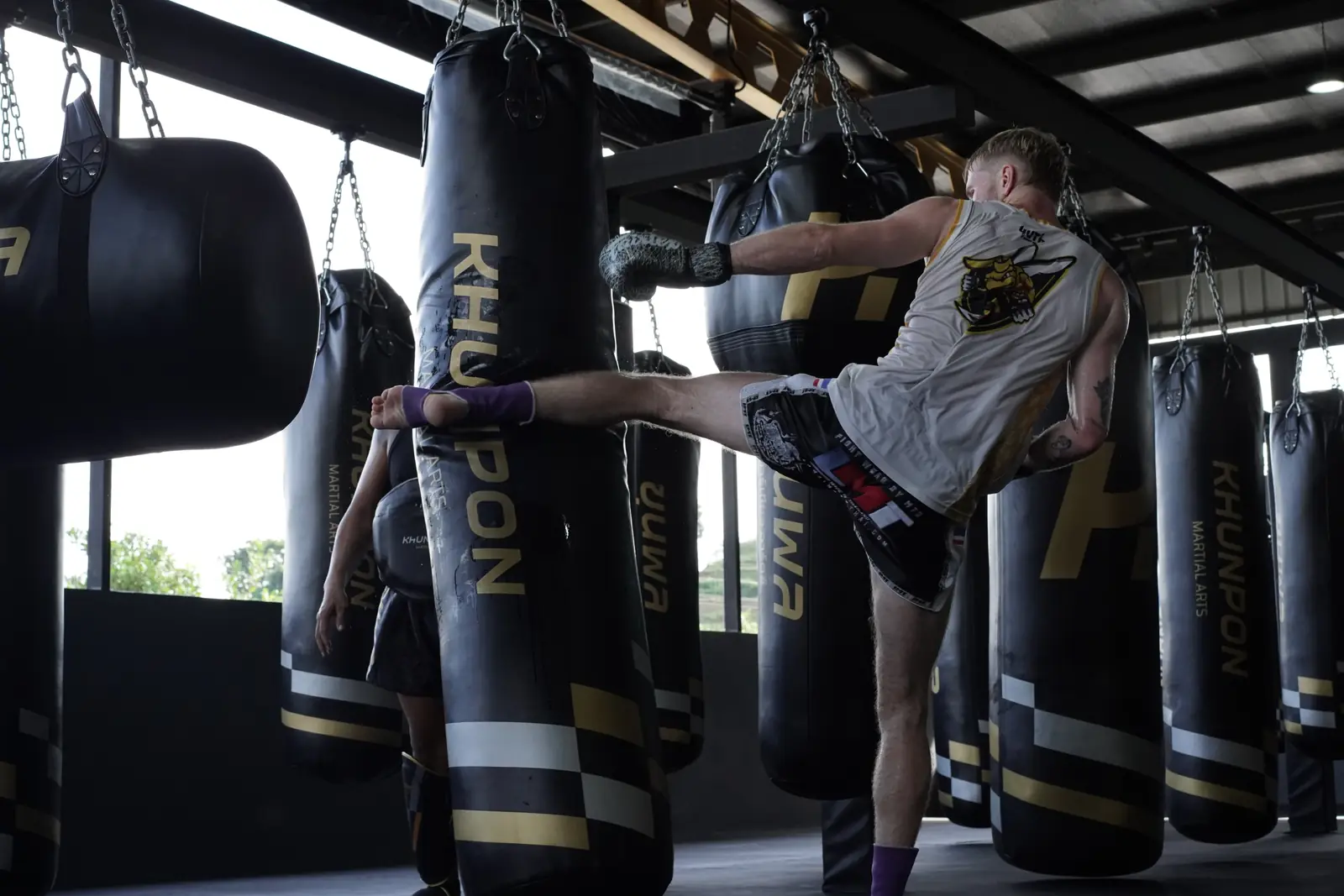
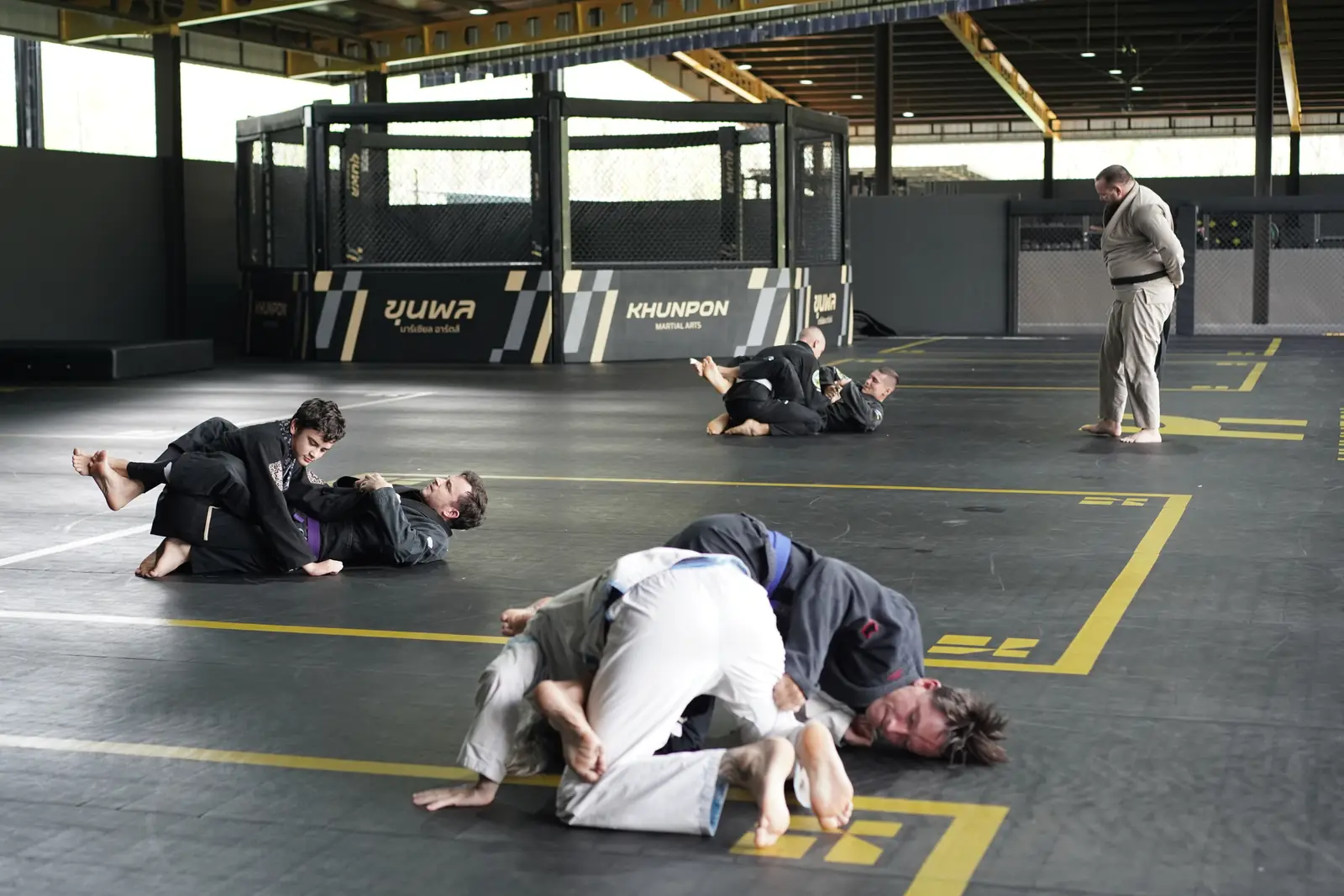
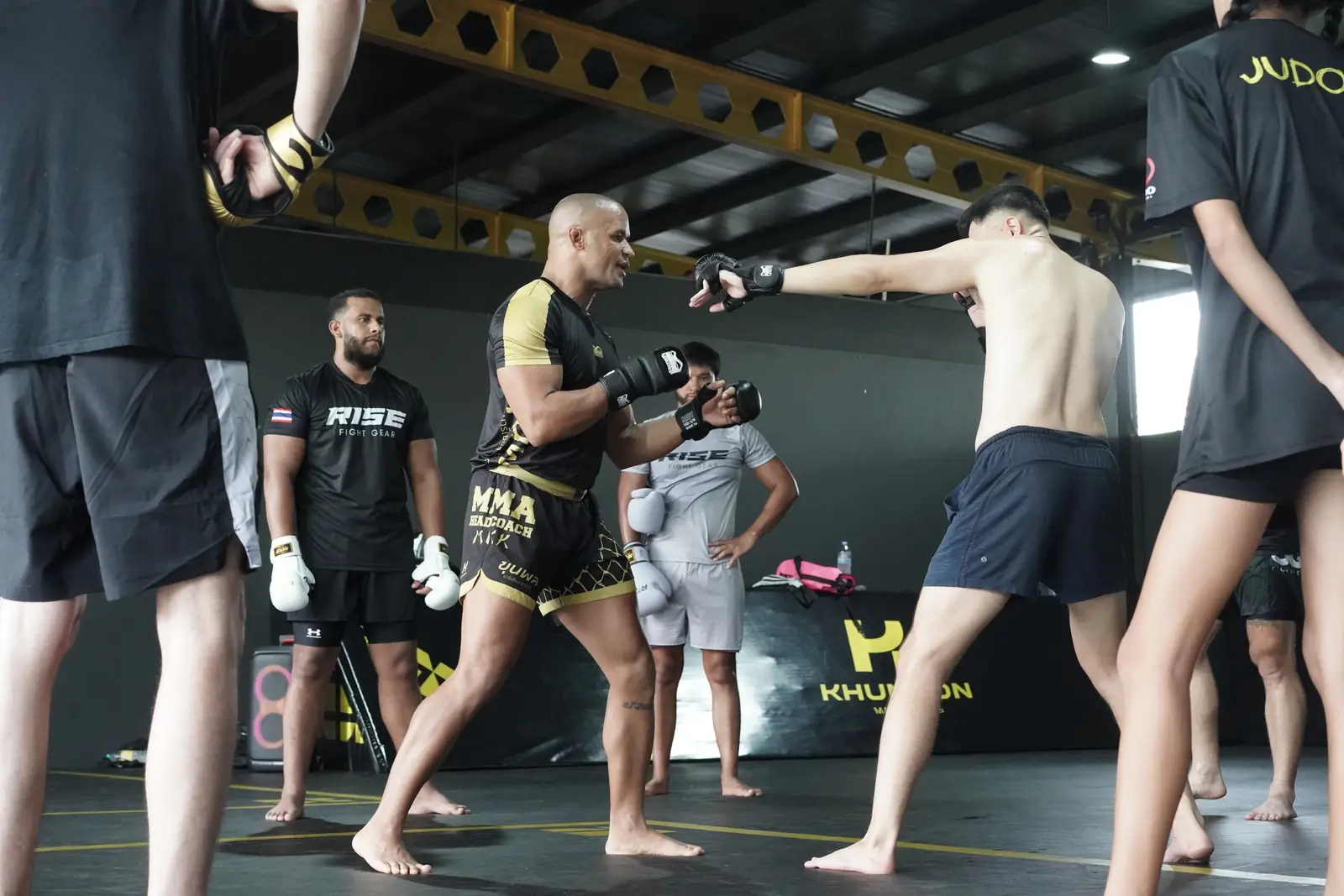
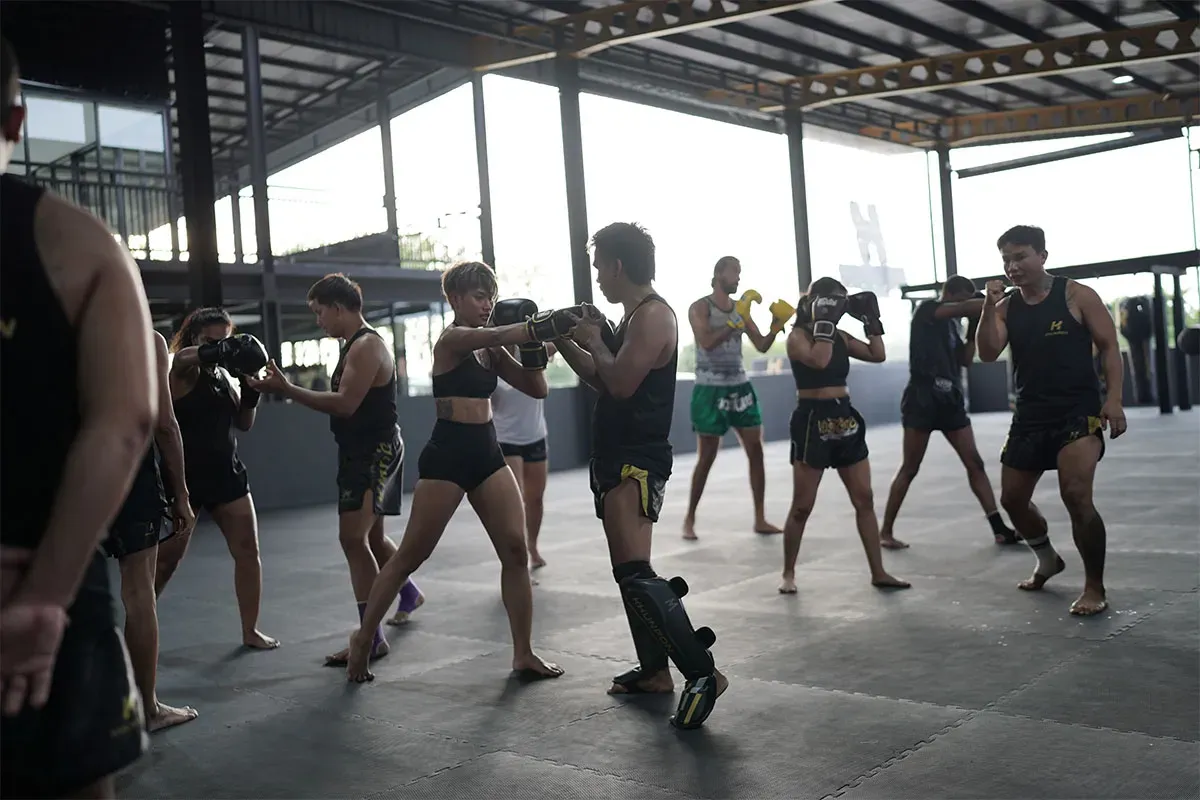
At Khunpon Martial Arts in Phuket, HYROX training brings those elements together through weekday classes, a dedicated HYROX team, full race simulations and a wider gym that includes strength and conditioning, Muay Thai, MMA and BJJ.
Khunpon is an official HYROX Training Club. HYROX classes run Monday to Friday from 17:30 to 18:30, with an extra Friday morning class at 09:30. Some members train for official races; others come to improve their conditioning, strength and confidence without planning to compete.
What is HYROX?
HYROX is made up of eight 1 km runs and eight functional stations. You complete one run, then one station, and repeat the sequence eight times:
- 1 km run, then 1,000 m SkiErg.
- 1 km run, then 50 m sled push.
- 1 km run, then 50 m sled pull.
- 1 km run, then 80 m burpee broad jumps.
- 1 km run, then 1,000 m rowing.
- 1 km run, then 200 m farmers carry.
- 1 km run, then 100 m sandbag lunges.
- 1 km run, then 100 wall balls.
That is 8 km of running in separate 1 km sections, plus all eight stations. The format is standardised across events, although weights, categories and race rules should always be checked against the current season's rulebook.
The combination is what makes HYROX different from a normal circuit class or an obstacle race. The exercises are familiar; the challenge is doing them after running, then having to run again. You need aerobic fitness, strength endurance, movement quality, pacing and the ability to make sensible decisions while tired. Those are exactly the qualities Khunpon's HYROX sessions are built to develop.
Why has HYROX become so popular?
HYROX draws people from different corners of fitness because it offers a clear challenge without demanding one specific athletic background. Runners work on sleds, carries and wall balls. Strength athletes build their running and aerobic base. Gym members enter Doubles or Relay with friends. Experienced racers use the standard format to measure progress over time.
Its popularity rests on a few features:
- The race has a clear, recognisable format.
- The movements are challenging but easy to understand.
- You can compete in Singles, Doubles or Relay.
- Open and Pro divisions offer different levels of challenge.
- Results can be compared between events.
- Training naturally builds a strong sense of shared preparation.
- Race weekends bring together athletes from many countries and backgrounds.
HYROX itself reported more than 90,000 athletes in the 2022-23 season, and its event network keeps growing internationally. Those are HYROX's own promotional figures, but the appeal is easy to understand: the race gives people a practical reason to train consistently.
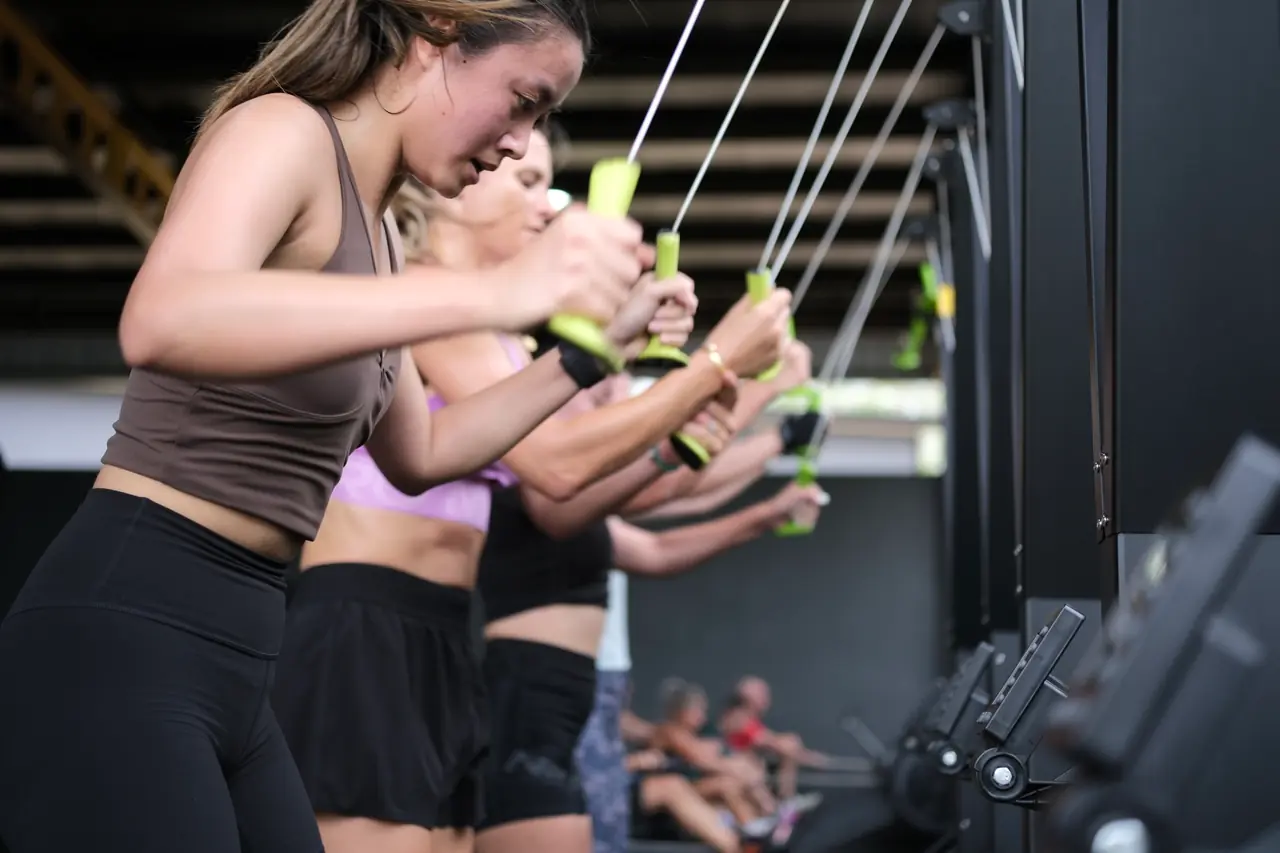
At Khunpon you can see that shared purpose in how members train together. One class may include someone preparing for a first event, a runner learning to handle a sled and an experienced athlete working on race pacing, each working on a different weakness inside the same format.
How did HYROX begin?
HYROX was founded by Christian Toetzke, an experienced mass-participation race organiser, with Moritz Fürste, a multiple world champion and Olympic medallist in field hockey, and marketing specialist Michael Trautmann. The concept was developed in Germany and launched in Hamburg in 2017, establishing the basic format of alternating 1 km runs and functional stations.
The idea was to connect traditional gym training with endurance racing. Instead of asking people to specialise as runners or as strength athletes, HYROX tests both in the same event. The format has since spread across Europe, North America and the Asia-Pacific region, and grown to include Singles, Doubles, Relay, age-group categories and adaptive divisions where offered.
Khunpon's approach follows the same practical principle: explain what the race demands, practise each component, then put them together through realistic combinations and full simulations.
The eight runs and stations
The requirements below follow the current HYROX Singles Rulebook for Season 26/27. Divisions use different loads, and future seasons may change the specifications.
| Run | Station | Requirement | Main challenge |
|---|---|---|---|
| Run 1 | SkiErg | 1,000 m | Upper-body endurance and pacing |
| Run 2 | Sled push | 50 m | Leg drive and bracing |
| Run 3 | Sled pull | 50 m | Pulling strength and grip |
| Run 4 | Burpee broad jumps | 80 m | Whole-body conditioning |
| Run 5 | Rowing | 1,000 m | Repeatable power and breathing |
| Run 6 | Farmers carry | 200 m | Grip and trunk stability |
| Run 7 | Sandbag lunges | 100 m | Single-leg strength and control |
| Run 8 | Wall balls | 100 reps | Squat endurance and accuracy |
Run 1 and the SkiErg
The SkiErg is the opening station: 1,000 m of repeated downward pulls using the arms, trunk and legs. It comes first, but it is not necessarily a maximal effort. Starting too hard can hurt the first sled push and the run after it; a controlled rhythm and efficient breathing set up a sustainable pace. At Khunpon, SkiErg work is used to practise pacing and the switch from a machine back into running.
Run 2 and the sled push
The sled push covers 50 m, usually split into shorter lengths. You drive a weighted sled forward with your legs while holding a strong body position. For Season 26/27 Singles, the listed totals, including the sled itself, are 102 kg for Women Open, 152 kg for Women Pro and Men Open, and 202 kg for Men Pro.
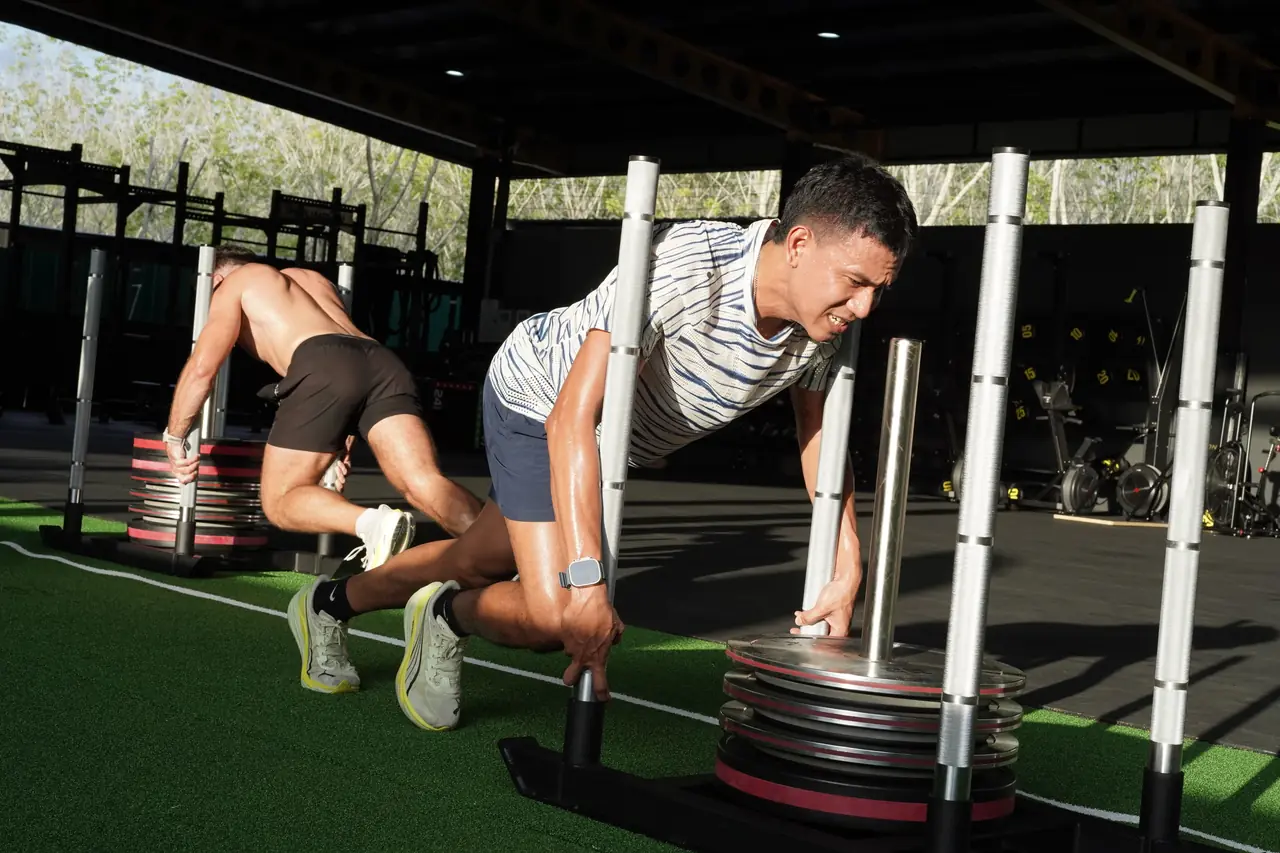
The load is only part of the challenge. Surface friction, sled construction and lane conditions all change how the sled moves, so a load that feels manageable in one gym can feel different at an official race. Khunpon sessions build leg drive, bracing and repeated pushing while teaching you to manage effort before the next run.
Run 3 and the sled pull
The sled pull covers 50 m using a rope: you pull the sled towards you while managing your stance, body angle and grip. It exposes poor pacing quickly. Short, controlled pulls are usually more sustainable than big, inconsistent bursts, and grip fatigue matters because carries and other hard stations are still to come. Sled-pull practice at Khunpon focuses on position, rope control and holding technique with your breathing already high.
Run 4 and burpee broad jumps
Burpee broad jumps cover 80 m: each rep is a burpee followed by a forward jump. The current rules require the chest to reach the floor and the take-off and landing to meet the prescribed standards. After three runs and two sled stations this station spikes the heart rate, so you need a rhythm that is technically correct without turning every rep into a maximal jump. Coaching at Khunpon helps you move efficiently, manage jump distance and get back to running without an unnecessary pause.
Run 5 and rowing
The rowing station is 1,000 m, combining leg drive, trunk movement and the final arm pull before returning to the catch. A common mistake is raising stroke rate without keeping useful power; stronger rowing usually comes from coordinated leg drive and a controlled recovery rather than pulling harder with the arms. Khunpon uses rowing intervals and run-to-row combinations to build repeatable output, so you finish the row with enough left for the next 1 km.
Run 6 and the farmers carry
The farmers carry covers 200 m holding two kettlebells, loading your grip, shoulders, posture and trunk. Rush it and your grip may fail early; creep along and you lose time. You need to know your sustainable carry distance and how to take short, controlled breaks if you have to.
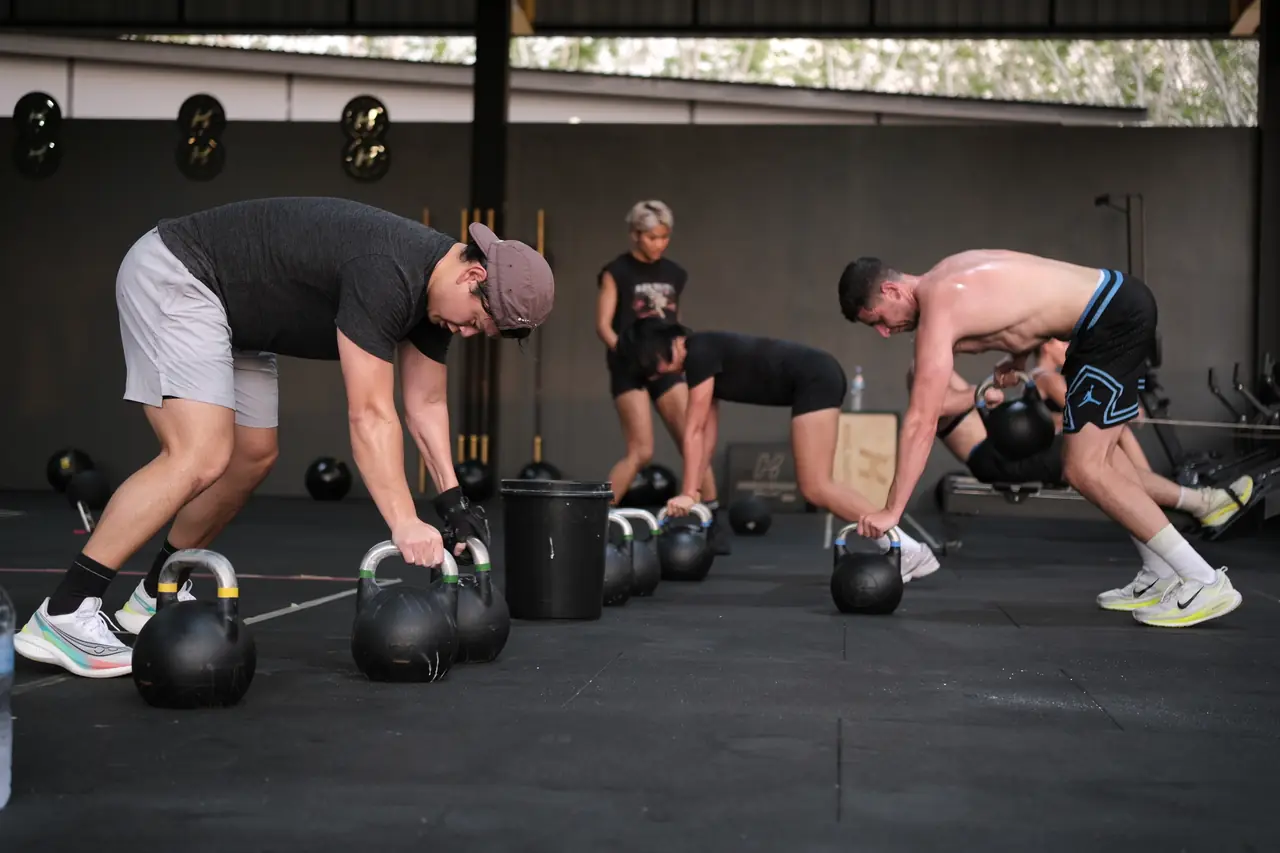
At Khunpon, carries are combined with running or other stations to recreate moving with hands and forearms that are already fatigued.
Run 7 and sandbag lunges
The sandbag lunge covers 100 m of alternating lunges with a sandbag, the trailing knee touching the floor before you return to full extension. Loaded lunges challenge balance, leg strength and coordination, and they change how the next run feels because each leg has worked on its own under load. Khunpon coaches build the control you need gradually, through loaded lunge variations, station intervals and transitions back into running.
Run 8 and wall balls
The final station is 100 wall balls: squat and throw a medicine ball to a set target height. Ball weight and target height depend on your division. Wall balls are a test of pacing and breathing: small planned sets, longer sets or short breaks, depending on your experience, division and current conditioning.
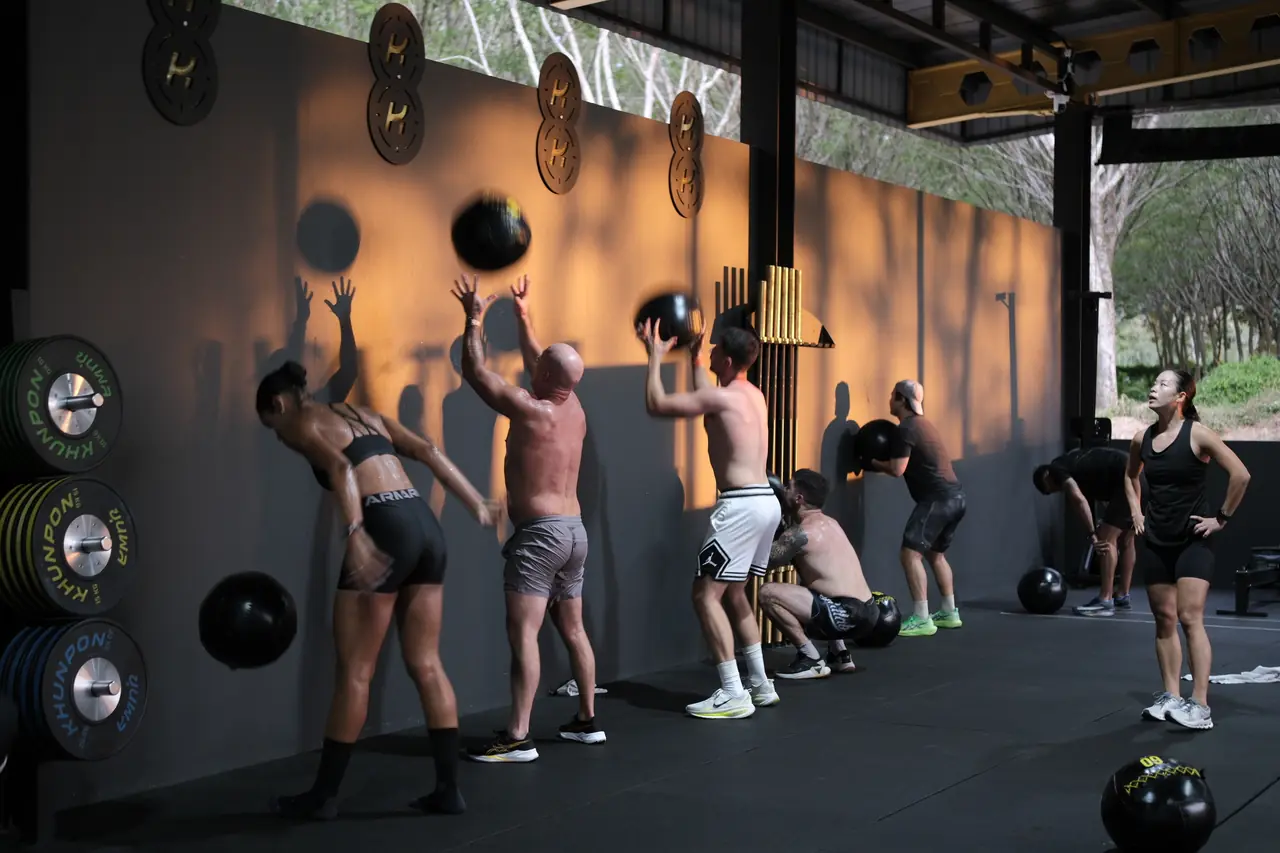
At Khunpon you practise set strategies, movement standards and accurate target contact, so you reach the last station with a plan rather than improvising under fatigue.
Singles, Doubles and Relay
HYROX offers several ways to race. In Singles, one athlete completes every run and every station, with Open and Pro divisions using different weights for different levels of challenge.
Doubles is a two-person format. Both partners run together, and the station work is divided between them according to the rules. You need to communicate clearly, agree who starts each station and swap without unnecessary delays. Doubles is not half a Singles race: each athlete still runs the full distance, and partners must stay together on the runs.
Relay is for a team of four, with the running and stations divided between teammates. It is an accessible way to experience the event as a group.
The right choice depends on your goals. Khunpon's classes support people preparing for any of these formats, as well as members who simply want to get fitter.
What is the Roxzone?
The Roxzone is the transition area between the running course and the stations. It is where you enter a station, find your lane or equipment, complete the work and return to the running route.
Transitions count towards your race time, so you need to know where you are going, understand the station order and avoid standing around or getting lost. Roxzone layouts vary between venues, so no training can reproduce every race exactly, but a full simulation lets you practise moving from running to station work and back again. That is one reason Khunpon's full HYROX simulations are so useful: you rehearse the complete sequence, including pacing, equipment, movement standards and transitions.
Details that make a difference
HYROX performance depends on how the parts of the race interact.
Compromised running
"Compromised running" means running after a demanding station, when your legs, grip, breathing or posture are affected by the work you just did. The run after the sled push feels different from the run after the row. The run after the farmers carry is shaped by grip and trunk fatigue, and the final run needs enough control that you do not arrive at wall balls completely empty. Train the runs as part of the event, not as rest between stations.

Strength versus strength endurance
Maximal strength is the greatest force you can produce. Strength endurance is producing useful force again and again over time. HYROX needs both, but it is rarely decided by one maximal effort: you might push a sled, run, pull a sled, run again and keep working for more than an hour. Research on concurrent strength and endurance training suggests combining both can be effective, although structure, intensity, recovery and experience shape the outcome. That supports Khunpon's balanced approach, developing strength, running and race-specific conditioning together.
Pacing and planned breaks
A fast first kilometre does not guarantee a fast finish. Think about how each effort affects the stations and runs that follow. Planned breaks can work better than waiting until your technique falls apart, particularly on wall balls, lunges and carries, where a controlled pause can prevent a longer stop later.
Movement standards and no-reps
Official races judge movement standards: a rep may not count if it misses the required depth, extension, target height or distance. Learning the standards before race day removes uncertainty, and Khunpon simulations let you practise the correct movements while fatigued, although official judging and venue conditions may still differ.
Doubles and Relay communication
Team formats need communication as well as fitness. Partners and teammates need to know when to change, where to move and how to respond if someone's pace drops. Training together at Khunpon lets teams practise those decisions before they reach an official event.
HYROX in Southeast Asia and Thailand
HYROX's Asia-Pacific calendar now includes cities such as Jakarta, Bangkok, Singapore, Taipei and Osaka. Jakarta and Bangkok matter to Khunpon because members of the gym's HYROX team have raced at both.
At HYROX Jakarta 2026, where the HYRESULT event page lists 11,204 athletes across the divisions, the Khunpon relay team of Alexis Hardenberg, Sacha De Souza, Rae Ann Collier and Sue Kansinee Phumipol recorded 1:08:30 in the Mixed Relay. HYRESULT lists them fifth in the U40 age group, just 45 seconds off the podium.
The same four raced together again at HYROX Bangkok 2026, where the event page lists 19,664 athletes. Their Mixed Relay time was 1:05:59, and HYRESULT again lists them fifth in U40.
That regional calendar gives Phuket-based athletes a practical route into the sport: train at Khunpon, prepare locally, take part in gym simulations and travel to official events in Thailand or nearby countries when ready.
World Championships and major events
HYROX seasons include regular participation events alongside larger championship and elite-level competitions. The World Championships are the top championship level of each season, with qualification through age-group places and other routes set out in the current rules. Requirements change, so check the rulebook for the relevant season rather than older explanations.
Age groups and divisions are separate classifications. A strong Open result does not automatically qualify you for Pro or Elite racing, and entering Pro does not automatically qualify you for the World Championships.
The event structure has room for very different ambitions: some athletes want to finish a first race, others are chasing an age-group qualification or a higher competitive pathway. Khunpon supports that range through its group training community and race-specific preparation, and the gym's team shows what preparation can look like without suggesting every member must follow the same route.
What is the Elite 15?
The Elite 15 is a separate top-level racing format for leading licensed Pro athletes and Doubles teams. Qualification uses ranking points and invitation pathways for eligible athletes; the Elite 15 is linked to the World Championship structure, but it is not the same as entering a standard Pro race.
Standard Open and Pro races remain open to a much broader range of competitors. A Pro athlete does not automatically become an Elite 15 athlete, and being on a local gym team does not imply Elite 15 status.
For most people training at Khunpon, the real goal is finishing a first HYROX, choosing the right division, beating a previous time or preparing for a Doubles or Relay race. The Elite 15 is the top end of the sport, but the principles are the same for everyone: consistency, technical accuracy, intelligent pacing and preparation for the full sequence.
Khunpon's HYROX team and full simulations
Khunpon's HYROX team gives the programme a competitive foundation while the training stays open to every level. The team's relay races in Jakarta and Bangkok show how much HYROX preparation depends on shared work: relay racing means understanding your role, communicating under pressure and contributing to a collective result.
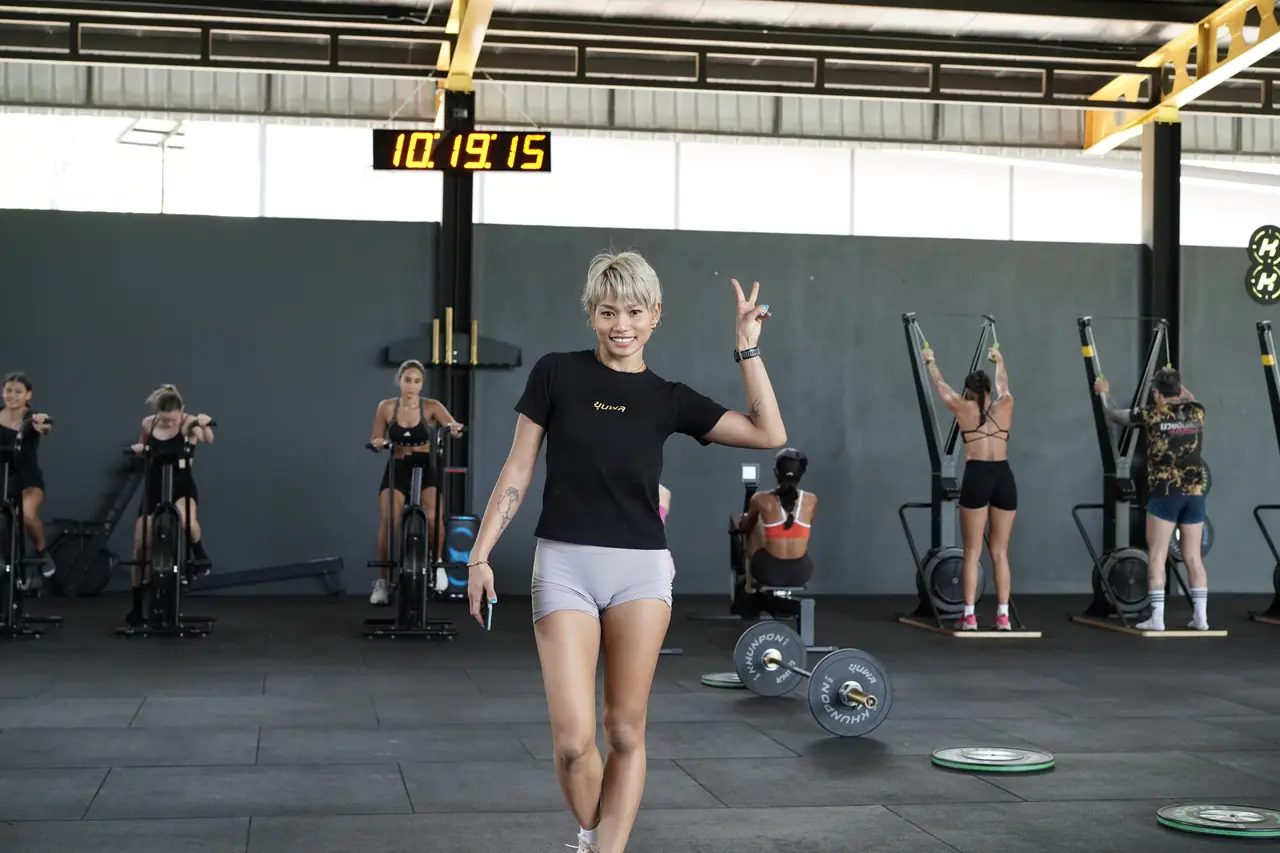
Khunpon's first full HYROX simulation took place on 7 March 2026, with 30 heats of Singles and Doubles athletes across Open and Pro. Participants completed the full 8 km of running and all eight stations at race weights. It was supported by the Khunpon team and athletes, and helped people prepare for the Bangkok race that followed. Thirty heats did not mean thirty people: each heat could include several Singles and Doubles athletes.
It was a Khunpon-organised gym simulation, not an officially sanctioned HYROX race, and it had no event sponsors or partners. Its value was practical: the chance to experience the complete structure, practise transitions, manage pacing, get to know the equipment and communicate with training partners. People asked straight away when the next one would be, and the second simulation followed. The team has also taken HYROX-style training outside the gym, at HYROX by the Beach with Amora Beach Resort.
Why train for HYROX at Khunpon?
Khunpon combines official HYROX Training Club status with a wider training environment in Phuket. Members can use:
- HYROX group classes Monday to Friday, 17:30 to 18:30, plus Friday at 09:30.
- A dedicated Khunpon HYROX team and athlete community.
- Full HYROX simulations.
- Strength and conditioning training.
- Muay Thai, MMA and BJJ programmes.
- A welcoming gym for every experience level.
- Khunpon Kitchen, the on-site café.
The benefit is flexibility. A runner can use HYROX and strength-and-conditioning sessions to build the qualities the stations need. A martial artist can build running endurance and repeated-effort capacity. A beginner can learn the movements step by step. An experienced racer can focus on pacing, standards, transitions and race preparation.
Khunpon's community is built by people training alongside one another, sharing equipment, supporting different goals and coming back consistently. Not everyone is preparing for a race, but everyone finds a useful reason to train.
Find your HYROX home at Khunpon
Whether you are preparing for your first HYROX, training for Doubles or Relay, building your conditioning or looking for a structured challenge, Khunpon Martial Arts welcomes you. Join HYROX training Monday to Friday from 17:30 to 18:30 and train alongside beginners, experienced athletes and the Khunpon team in Phuket.
See the HYROX programme, check the timetable or message the team to book your first class.
HYROX glossary
- HYROX
- A fitness race combining eight 1 km runs with eight functional stations.
- Singles
- One athlete completes every run and station.
- Open
- The standard division, with lighter prescribed loads than Pro.
- Pro
- A division with heavier prescribed loads.
- Doubles
- A two-person format in which both partners run together and share the station work.
- Relay
- A four-person format in which teammates divide the running and the stations.
- Roxzone
- The transition area between the running course and the stations.
- Compromised running
- Running after a demanding station, when fatigue affects your pace or movement.
- Strength endurance
- The ability to produce useful force repeatedly over time.
- No-rep
- A repetition that does not meet the required movement standard.
- Movement standard
- The official technical requirement for completing a movement.
- Race simulation
- A training event that reproduces some or all of the official HYROX sequence.
Sources and further reading14
- HYROX. Singles Rulebook, Season 26/27.
- HYROX. Doubles Rulebook, Season 26/27.
- HYROX. The History.
- HYROX. About the Race.
- HYROX. The Fitness Race.
- HYROX. Elite Series Overview.
- HYROX. Elite Series Qualification.
- HYROX. Asia-Pacific events.
- HYROX. The Science of HYROX.
- HYROX. Rulebooks.
- HYRESULT. HYROX Jakarta 2026 event page and Khunpon relay result.
- HYRESULT. HYROX Bangkok 2026 event page and Khunpon relay result.
- Huiberts, Wüst and van der Zwaard. Concurrent Strength and Endurance Training: A Systematic Review and Meta-analysis.
- Hughes et al. Adaptations to Endurance and Strength Training.